Solar PV Area & Output
Module count, row spacing, land area and annual energy for fixed-tilt and tracking arrays.
1. What this check does
Converts between DC capacity and area. For fixed-tilt arrays it finds the row pitch that keeps one row from shading the next during a chosen window around solar noon on the winter solstice, and from that the ground coverage ratio (GCR). Tracking arrays use a GCR you enter or a typical default. With the plane-of-array insolation for the site it estimates annual energy, specific yield, capacity factor and, optionally, avoided CO₂.
2. Inputs used
- Target DC kW, or the available area.
- Module rating (W at STC), length along the slope and width, and how many modules are stacked up the slope in a row.
- Mounting (fixed, single-axis, dual-axis), latitude, and for fixed arrays the tilt and the shade-free window.
- Optional: plane-of-array insolation from NREL PVWatts or the NSRDB, performance ratio, DC/AC ratio, and a grid emission factor from EPA eGRID.
3. Formulas and assumptions
Sun position (winter solstice, solar time)
φ = |latitude|, δ = −23.45°, h = 15° per hour from noon.
From due south (north in the southern hemisphere).
Row spacing and area
β tilt; L slope length = modules up × module length.
Energy
CF on DC matches PVWatts; utility statistics usually quote CF on the AC rating.
EF in lb/MWh (EPA eGRID).
Symbols
| Sun elevation; sun azimuth from due south | ° | |
| Latitude (absolute); solar declination; hour angle | ° | |
| Module tilt | ° | |
| Slope length of one row (modules up × module length) | m | |
| Row pitch; ground coverage ratio L/D | m, — | |
| Module count, module rating, module area | —, W, m² | |
| Plane-of-array insolation, annual average | kWh/m²/day | |
| Performance ratio (losses from DC rating to AC energy) | ||
| Annual energy; capacity factor | kWh/yr, — | |
| Grid CO₂ emission factor (EPA eGRID) | lb/MWh |
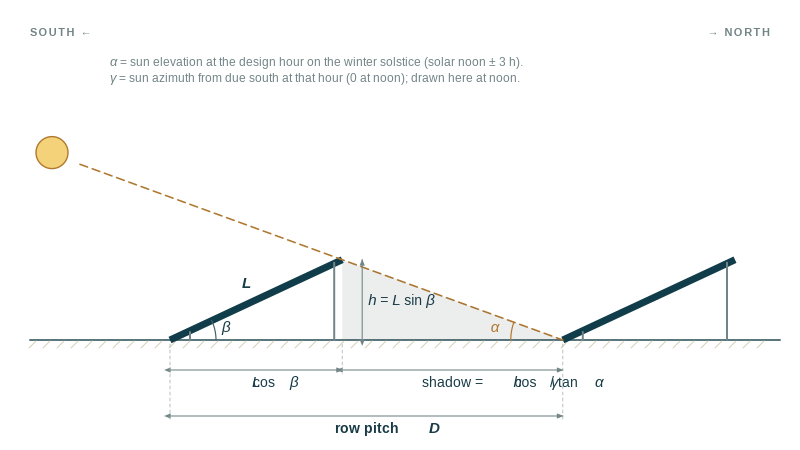
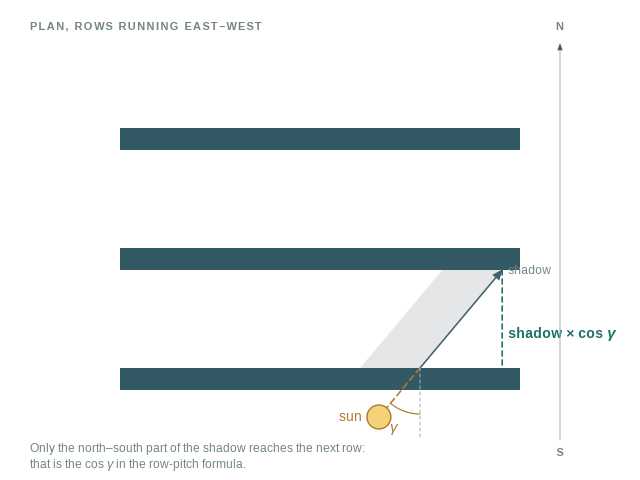
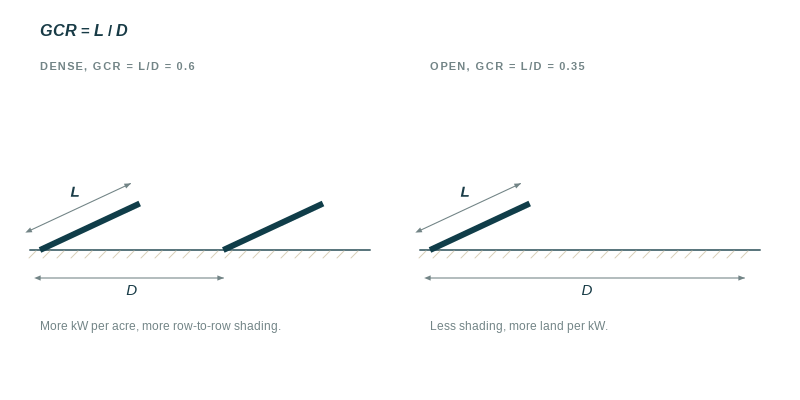
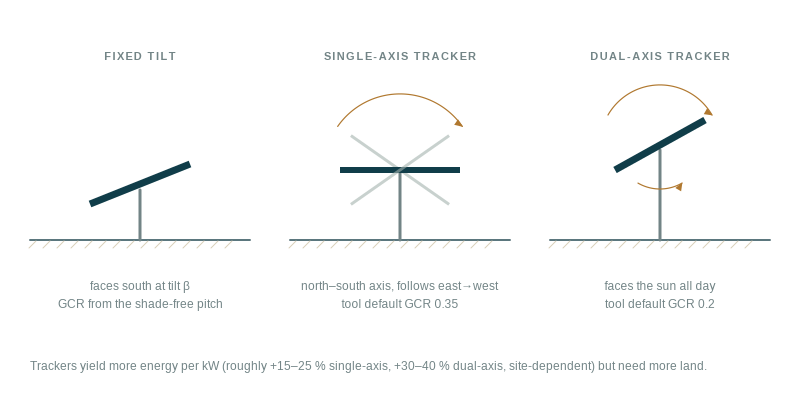
- Rows face due south (north in the southern hemisphere) on flat ground; slopes, azimuth offsets and edge effects are ignored.
- The declination of −23.45° is the solstice value; the shade-free window is in solar time, not clock time.
- Tracker GCR defaults are 0.35 (single-axis) and 0.2 (dual-axis), typical screening values chosen by RokBench; enter your layout value when known.
- Performance ratio default 0.80 is a RokBench screening assumption covering temperature, soiling, wiring, mismatch, inverter and availability losses. NREL PVWatts models these explicitly and is the better source.
- The plane-of-array insolation you enter must match the mounting and tilt. "Fill from coordinates" uses NASA POWER climatology (2001–2020): for fixed tilt it interpolates NASA's values for 0°, latitude − 15°, latitude, latitude + 15° and 90°; for trackers it uses the fixed optimal-tilt value, which leaves out tracker gain and so understates energy.
4. What is NOT checked
- Fire code roof setbacks and access pathways, and structural loading.
- String sizing, NEC 690 conductors, overcurrent protection and rapid shutdown.
- Inverter clipping (flagged above DC/AC 1.5), interconnection limits and export rules.
- Shading from terrain, trees and nearby objects; snow and bifacial gain.
5. Reference standards
Pointers only; consult the edition adopted by your authority having jurisdiction.
- NREL PVWatts Calculator and the National Solar Radiation Database (NSRDB) — U.S. DOE public data
- NASA Langley Research Center (LaRC) POWER Project — climatology API (public data)
- EPA eGRID2023 — emission rates by grid subregion and the Power Profiler ZIP code table (public data); non-baseload rates are EPA's suggested simple estimate of emissions avoided
- NEC 2023 Article 690 — solar photovoltaic systems
- Duffie & Beckman, Solar Engineering of Thermal Processes — solar geometry
6. Validation cases
These worked examples run through the engine on every change; the expected values come from the cited source. All cases: Validation.
Fixed-tilt array, 500 kWdc at 35° latitude, 30° tilt solar/pv · Hand calculation
PassSource: Hand calculation from the solar position equations (declination −23.45°, hour angle 15°/h) and row-shadow geometry — 09:00 solar time on the winter solstice: α = 17.646°, γ = 42.901°. Pitch = 2cos30° + 2sin30°·cos42.901°/tan17.646° = 4.0349 m; GCR = 2/4.0349 = 0.4957; land = 1250 · 2 / 0.4957 = 5043.6 m². Energy = 500 · 5.5 · 365 · 0.8 = 803,000 kWh.
| Quantity | Expected | RokBench | Error | Result |
|---|---|---|---|---|
| modules | 1250 | 1250 | 0% | Pass |
| pitchM | 4.0349 | 4.035 | 0.002% | Pass |
| gcr | 0.4957 | 0.496 | 0.061% | Pass |
| landAreaM2 | 5043.6 | 5043.6 | 0% | Pass |
| annualKwh | 803000 | 803000 | 0% | Pass |
7. Known issues and changes
See the Engineering Notes. Try the tool: Solar PV Area & Output.