Electrical Room Heat Load
How equipment losses are estimated and turned into BTU/hr, tons of cooling and ventilation airflow.
1. What this check does
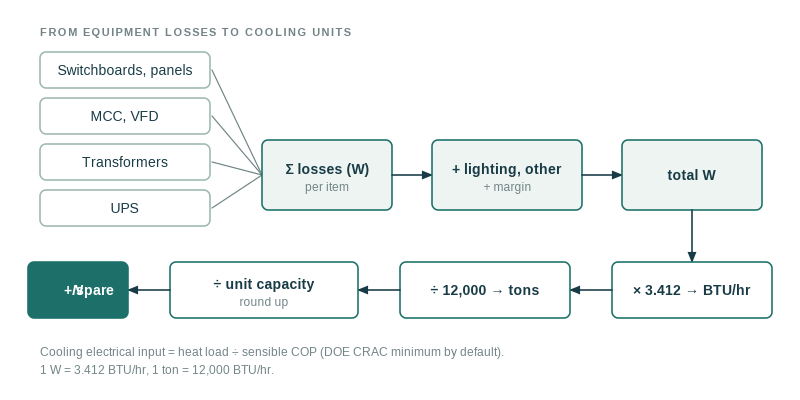
Estimates the heat released by each piece of equipment at its operating load, adds other gains and a design margin, and converts the total into BTU/hr, tons of refrigeration, a count of air-conditioning units with spares, and the airflow that would remove the same heat by ventilation.
2. Inputs used
- Each item: type, rating (amperes for switchgear, MCCs and panelboards; kVA for transformers and UPS; kW for VFDs and chargers; watts for other equipment), quantity and load percentage (default 80%).
- Optional overrides: watts per ampere for cabinets, efficiency for VFDs, UPS, chargers and transformers.
- Other gains (lighting, people, envelope), design margin, AC unit size and spare count, ventilation temperature rise.
3. Formulas and assumptions
Equipment losses
Losses at rated current, scaling with current squared.
PF 0.9.
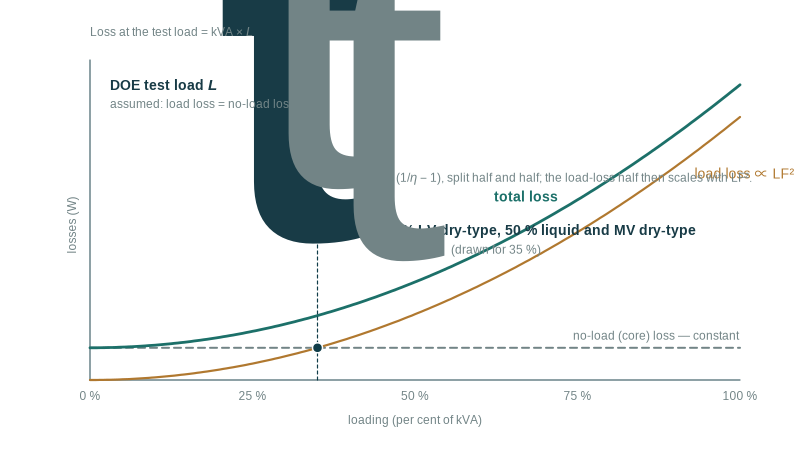
Transformer (DOE efficiency at test load Lt)
Lt = 35% LV dry-type, 50% liquid and MV dry-type (10 CFR 431.196).
Room
Sensible heat, standard air.
COP = DOE minimum NSenCOP for the CRAC class, or entered.
Symbols
| Loss per ampere at rated current; rated current | W/A, A | |
| Load factor (actual over rated) | ||
| Efficiency; power factor | ||
| DOE test load fraction; transformer loss at that load | —, W | |
| No-load (core) loss; load (copper) loss at rated load | W | |
| Design margin | ||
| Supply-to-room air temperature difference | °F | |
| Sensible coefficient of performance of the cooling unit |
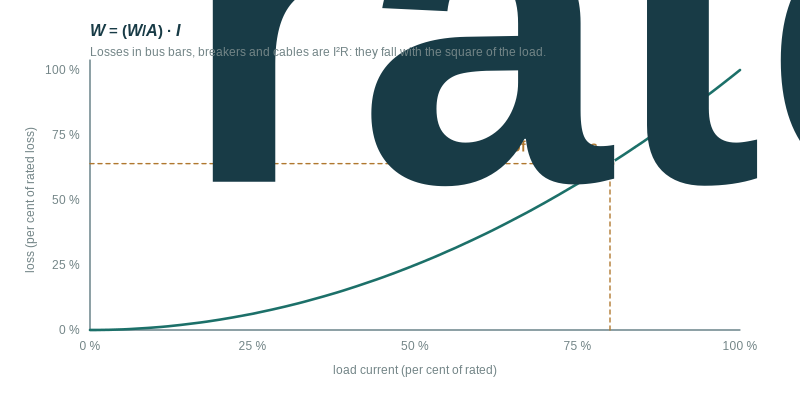
- Default cabinet losses at rated current are RokBench engineering assumptions: MV switchgear 0.4 W/A, LV switchboard 0.6 W/A, MCC 0.8 W/A, panelboard 0.4 W/A. They are screening values; manufacturer heat-loss data replaces them.
- Default efficiencies are RokBench assumptions: VFD 97%, UPS 95% (at PF 0.9), battery charger 90%.
- Transformer efficiency defaults to the US federal minimum (10 CFR 431.196, in force from 2016), interpolated linearly between listed kVA. The split into no-load and load losses assumes the transformer is most efficient at the test load, which puts half the test-load loss in each.
- All heat is sensible and released into the room; liquid-immersed transformers outdoors should not be listed.
- Ventilation airflow uses 1.08 BTU/hr per CFM·°F for standard air at sea level.
- Cooling power uses the minimum net sensible COP (NSenCOP, fans included, rated conditions) that US federal rules set for floor-mounted computer room air conditioners (10 CFR 431.97 Table 13), picked by medium, airflow and the capacity of one unit. Electrical-room heat is almost entirely sensible, so dividing it by a sensible COP gives the electrical input. Real units in hot weather draw more; use the selected unit's rated input when known.
4. What is NOT checked
- Envelope, solar, lighting and people loads unless entered as other gains.
- Altitude correction of airflow, humidity and latent loads.
- Equipment ambient temperature limits and hot-spot distribution in the room.
- HVAC redundancy philosophy beyond the spare count.
5. Reference standards
Pointers only; consult the edition adopted by your authority having jurisdiction.
- 10 CFR 431.196 — energy conservation standards for distribution transformers (U.S. federal regulation, public domain)
- 10 CFR 431.97 — energy conservation standards for commercial air conditioners, Table 13 computer room air conditioners
- ASHRAE Handbook — Fundamentals, load calculation methods
- IEEE Std C57.96 / C57.91 — transformer loading and losses (context)
- Manufacturer heat-loss data for switchgear, MCCs, drives and UPS
6. Validation cases
These worked examples run through the engine on every change; the expected values come from the cited source. All cases: Validation.
Electrical room: switchboards, panelboards, 75 kVA dry-type transformer, 100 kVA UPS room/heat · Hand calculation
PassSource: Hand calculation from the published loss equations; transformer efficiency 98.60% at 35% load from 10 CFR 431.196 (three-phase LV dry-type, 75 kVA) — Switchboards 0.6·2000·0.8²·2 = 1536 W; panelboards 0.4·225·0.64·4 = 230.4 W; transformer Pt = 75000·0.35·(1/0.986 − 1) = 372.7 W → 186.4 + 1521.3·0.64 = 1160.0 W; UPS 100·0.9·0.8·1000·(1/0.95 − 1) = 3789.5 W. (6715.9 + 500)·1.1 = 7937 W = 27,084 BTU/hr = 2.26 tons.
| Quantity | Expected | RokBench | Error | Result |
|---|---|---|---|---|
| equipmentW | 6716 | 6716 | 0% | Pass |
| totalW | 7937 | 7937 | 0% | Pass |
| btuPerHr | 27084 | 27084 | 0% | Pass |
| tons | 2.26 | 2.26 | 0% | Pass |
7. Known issues and changes
See the Engineering Notes. Try the tool: Electrical Room Heat Load.